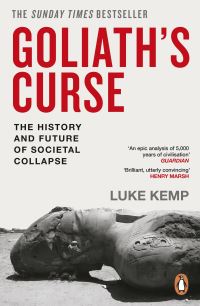
Book
Goliath's curse: the history and future of societal collapse
by Luke Kemp
On the shelf? Just pop in.
A new history of humanity told through the lens of collapse from Neanderthals to AI, and what it means for our uncertain future. A radical retelling of human history through collapse - from the dawn of our species to the urgent existential threats of the twenty-first century and beyond.** FEATURED IN THE NEW BBC SERIES CIVILISATIONS: RISE AND FALL **** THE SUNDAY TIMES BESTSELLER **`A brilliant, utterly convincing account of the evolution of human society and why we are probably reaching humanity's end days' HENRY MARSH'Absolutely essential reading for understanding why past civilisations collapsed, and how to protect our own from the same fate' LEWIS DARTNELLFor the first 300,000 years of human history, hunter-gathering Homo sapiens lived in fluid, egalitarian civilizations that thwarted any individual or group from ruling permanently. Then, around 12,000 years ago, that began to change. As we reluctantly congregated in the first farms and cities, people began to rely on novel lootable resources like grain and fish for their daily sustenance. And when more powerful weapons became available, small groups began to seize control of these valuable commodities. This inequality in resources soon tipped over into inequality in power, and we started to adopt more primal, hierarchical forms of organization. Power was concentrated in masters, kings, pharaohs and emperors (and ideologies were born to justify their rule). Goliath-like states and empires - with vast bureaucracies and militaries - carved up and dominated the globe. What brought them down? Whether in the early cities of Cahokia in North America or Tiwanaku in South America, or the sprawling empires of Egypt, Rome and China, it was increasing inequality and concentrations of power that hollowed these Goliaths out before an external shock brought them crashing down. These collapses were written up as apocalyptic, but in truth they were usually a blessing for most of the population. Now we live in a single global Goliath. Growth obsessed, extractive institutions like the fossil fuel industry, big tech and military-industrial complexes rule our world and produce new ways of annihilating our species, from climate change to nuclear war. Our systems are now so fast, complex and interconnected that a future collapse will likely be global, swift and irreversible. All of us now face a choice: we must learn to democratically control Goliath, or the next collapse may be our last.' An excellent survey of human history through the collapses of Goliath-like kings, states and empires' OBSERVER'A comprehensive overview of societal collapse, based on the analysis of dozens of cases spanning thousands of years from the Paleolithic to today. Highly recommended' PETER TURCHIN'A deeply sobering and strangely inspiring history of how societies collapse - and how we can still save ours. Read it now, or your descendants will find it in the ruins' JOHANN HARI'Like reading Thomas Piketty filtered through Mad Max' NEW YORK TIMES
- Genres
- History
- Language
- English
- Publisher
- Penguin Books
- ISBN
- 9781405974899
More like this

No fair maidens: a wild journey with the lost goddesses of Britain
Kim Willis · 2026

Not for disclosure: UFOs: the world's best kept secret
Jonathan Caplan · 2026

Queer Georgians: a hidden history of lovers, lawbreakers and homemakers
Anthony Delaney · 2026

Fantastic kingdom: a stranger's notes on a contrary country
Helene von Bismarck · 2026

The Moors murders: the definitive history of one of the most notorious criminal cases in Britain
Michael Attwell · 2026

The August coup: the destruction of the Soviet Union and the making of new Russia 1985-1991
Robert Service · 2026

The Zorg: a true story of greed and murder that inspired the abolition of slavery
Siddharth Kara · 2026

1873: the first great depression and the making of the modern world
Liaquat Ahamed · 2026

Homeward bound: the joy of nature and my life outdoors
Hamza Yassin · 2026

Blood dawn: World War II and the making of modern Asia
Hans J. Van de Ven · 2026

World Cup fever: a footballing journey in nine tournaments
Simon Kuper · 2026

The electron: a biography
Brian Clegg · 2026